
Availability:
In Stock
- Pages: 128
- Book Size: 6.00 x 9.00
- ISBN-13: 9781644117262
- Imprint: Destiny Books
- On Sale Date: September 23, 2025
- Format: Paperback Book
- Illustrations: 35 b&w illustrations
A transformative perspective on the sacred feminine origins of the runic alphabet
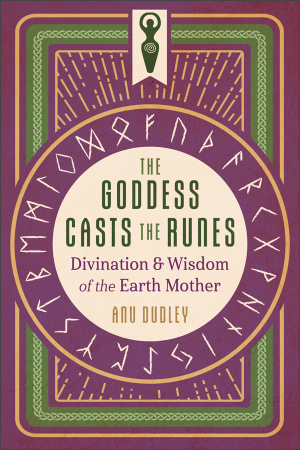
Dudley shows how the roots of the runes lie in Mother Goddess lore rather than the Odin-centric mythology that dominates interpretations. By examining each rune from an eco-feminist viewpoint, readers receive a more comprehensive understanding of their significance. Learn ways to interpret runes from an Earth-based spiritual perspective while exploring different casting and divination methods.
Dudley shows how the roots of the runes lie in Mother Goddess lore rather than the Odin-centric mythology that dominates interpretations. By examining each rune from an eco-feminist viewpoint, readers receive a more comprehensive understanding of their significance. Learn ways to interpret runes from an Earth-based spiritual perspective while exploring different casting and divination methods.
• Explores the primordial foundations of the Elder Futhark in Mother Goddess lore, offering an alternative to the male-oriented ideologies that have historically shaped runic interpretation
• Examines each rune from an eco-feminist viewpoint, offering readers a more comprehensive understanding of their significance
• Shows how to interpret runes from an Earth-based spiritual perspective, exploring divination methods, casting techniques, and ethical considerations for rune readings
Examining each rune from a feminist and Goddess-oriented viewpoint, Anu Dudleyshows that the roots of the runes lie in Mother Goddess lore rather than the Odin-centric mythology that has long dominated interpretations.
Offering a more comprehensive understanding of their significance in relation to feminine energy and the Triple Goddess—the triad of Maiden, Mother, and Crone—Dudley delves into the primordial foundations of the Elder Futhark, intertwining themes of ecofeminism and Earth-based spirituality to provide a compelling alternative to the male-oriented ideologies that shape runic interpretation. She also addresses Odin’s appropriation of the runes and their treatment in the Hávamál poem, highlighting how their meanings were rebranded within a patriarchal culture. Dudley then shows how to read and interpret runes from an Earth-based spiritual perspective, offering methods of divination aligned with the feminine. She also discusses casting techniques and considerations for rune interpretation.
Reframing the runes as symbols of our connection with the living world and setting aside male-oriented hero myths, this book rediscovers an ancient, intuitive, Earth-based spirituality that reveals the runes as representations of the Earth Mother ideals of compassion, wisdom, and justice.
• Examines each rune from an eco-feminist viewpoint, offering readers a more comprehensive understanding of their significance
• Shows how to interpret runes from an Earth-based spiritual perspective, exploring divination methods, casting techniques, and ethical considerations for rune readings
Examining each rune from a feminist and Goddess-oriented viewpoint, Anu Dudleyshows that the roots of the runes lie in Mother Goddess lore rather than the Odin-centric mythology that has long dominated interpretations.
Offering a more comprehensive understanding of their significance in relation to feminine energy and the Triple Goddess—the triad of Maiden, Mother, and Crone—Dudley delves into the primordial foundations of the Elder Futhark, intertwining themes of ecofeminism and Earth-based spirituality to provide a compelling alternative to the male-oriented ideologies that shape runic interpretation. She also addresses Odin’s appropriation of the runes and their treatment in the Hávamál poem, highlighting how their meanings were rebranded within a patriarchal culture. Dudley then shows how to read and interpret runes from an Earth-based spiritual perspective, offering methods of divination aligned with the feminine. She also discusses casting techniques and considerations for rune interpretation.
Reframing the runes as symbols of our connection with the living world and setting aside male-oriented hero myths, this book rediscovers an ancient, intuitive, Earth-based spirituality that reveals the runes as representations of the Earth Mother ideals of compassion, wisdom, and justice.
ORIGIN OF THE RUNES
The runes have long been associated with the Germanic cultures of northern and western Europe. The oldest runic symbols yet discovered were inscribed on the Meldorf Brooch, an artifact unearthed on the west coast of Jutland, in what is now Denmark, dating from the middle of the first century CE. By 250 CE, runic symbols were found throughout Germanic regions, inscribed on what appear to have been talismans. By the Middle Ages, the runes had been consolidated into a kind of writing system, although one that was never in wide use. It was the rise of the Vikings during the eighth century that brought the runes to the attention of the larger world, and today many people think of the runes mainly as symbols used by the Vikings.
During the nineteenth century, Europeans experienced an occult revival and some groups in Germany saw the runes as Aryan symbols of a so-called “Master Race.” The runes were later appropriated by the Nazis in the twentieth century to signify their national and racial superiority. In a few instances today, some runes are still used to symbolize white supremacy beliefs.
But the runes have another story to tell. This brief history of the runes is by no means complete, for it does not include the ancient feminist origins of the symbols that would eventually coalesce into the runic system. Understanding the runes’ beginnings enables us to fully understand their rich, complex meanings and their importance to us today.
The purpose of this book is to provide an ecofeminist, Earth-based perspective on the runes that takes into account salient principles of feminism, environmentalism, and the sacredness of the Earth as well as the archaeological, mythological, spiritual, and etymological origins and significance of the runes. It reclaims the runes for the Mother Goddess, whose grace and power these ancient symbols were originally created to honor. We will learn how these symbols were developed by our ancestors over a span of tens of thousands of years, and how they reflect the totality of human experience—life’s blessings, challenges, and relationships—making them a repository of the wisdom our ancestors gained from uncounted generations of living on this Earth. We will also learn how this wisdom applies to our current world as we cast the runes to answer today’s life questions.
IN THE BEGINNING
Humans are believed to have originated in Africa; as the Earth’s climate changed and the glaciers receded, our ancestors migrated into new regions that were previously uninhabited. Although humans developed many variations as a result of this diaspora, such as physical appearance and adaptations to new landscapes, their languages and cultures remained “genetically related,” in the words of linguists and archaeologists. In time these related languages and cultures spread throughout Europe and much of Asia, and this vast inter-continental, racially diverse swath of the planet became known as the Indo-European region. Linguists now divide Indo-European languages into ten distinct, though related, branches, among them Germanic, Celtic, Italic, Greek, Slavic, and Indo-Aryan. Studies of early Indo-European cultures document a common cultural heritage as well, such as matrifocal social structures, Mother Goddess veneration, and practices of Earth-based spirituality. As we shall discover, the runes manifest this shared linguistic and cultural heritage in surprising ways.
Some scholars have characterized the runes as “embryonic writing” or, at best, as a rudimentary alphabet derived from the writing systems of the Greek and Roman civilizations. But the symbols that would become the runes existed long before these alphabets were developed. Furthermore these symbols were not created to be tools for literacy. To begin with, the word rune means “secret” or “mystery,” suggesting that runes were meant to represent esoteric concepts. Evidence from archaeologists shows us that the runes resemble a number of ancient ideographs—picture symbols that represent ideas. These ideographs have been unearthed at Neolithic sites throughout the Indo-European region and appear to have been used for ritual purposes such as blessing, healing, and protection. It would be many thousands of years before these symbols would be consolidated into the wisdom system we now call the runes.
THE RUNES TODAY
Today we know the runes as a collection of twenty-four symbols that comprise the Futhark. The word Futhark is made up of the beginning sounds of the first six runes—F, U, Th, A, R, and K—in the same way that we derive the word alphabet from the first two letters of the Greek system, alpha and beta. If you were to explore the half dozen or so runic systems that had been developed by the time of the Middle Ages, you would find variations among them in terms of names and shapes. But since we are examining the runes from the perspective of Mother Goddess lore and exploring their primordial, Earth-based origins, we will only be looking at the oldest system, known as the Elder Futhark.
Unlike some of the later runic scripts, the runes of the Elder Futhark are made using only straight lines. This is because the runes were originally carved onto hard surfaces like bone, wood, or stone and it was far easier to make straight lines on these materials than to carve circles or curves. In this regard, the runes are like stick figures that symbolize ideas.
Linguists question whether there was ever any significance to the order of the runes within the Futhark. This order, however, has remained constant for well over a thousand years, suggesting that there was an original significance to its sequence. The runes have also traditionally been divided into three equal segments called aettir (AY-teer). Aettir is an Old Norse word meaning families or kinships, leading us to conclude that the runes in each segment are related to one another in a specific way.
The runes have commonly been depicted as residing in rows, which is the conventional way of ordering letters that are used for writing. But the runes were not originally created to be tools for literacy and were—in earlier times—found in sequences, carved into such shapes as circles and undulating loops. As I learned more about these earlier rune depictions, I began to conceive of each aett (singular form of aettir) as an arc rather than a straight line, with the three aettir arcs together making a complete rune circle.
Traditionally, each aett has been linked to a particular Norse deity—the first aett is linked to Freyja, the second to Heimdallr, and the third to Tyr. However, since the intention of this book is to reclaim the runes for the Mother Goddess, my convention is to name the three aettir arcs for the Triple Goddess—the triad of Maiden, Mother, and Crone. The characteristics of the three members of this triad help us better understand the deeper meanings of the runes that reside together within each arc.
The first arc, containing the beginning eight runes, belongs to the Maiden. The Maiden radiates the eagerness to embrace life. Her perspective is joyous, and she declares with wonder, “Look what I have! Look what I can do!” The Maiden possesses her gifts simply because she is alive, and she exudes confidence and joie de vivre—the joy of being alive. The runes in this arc represent the fundamental blessings we receive from Mother Earth because we are her beloved children. These blessings generally pertain to us personally, although we share them with others. The Maiden Arc can be called the Birthright Arc, and contains the gifts of wealth, energy, connection, agency, purpose, knowing, gratitude, and desire.
The second arc, comprising the middle eight runes, is the Mother Arc. Although the runes in this segment warn of challenges, these problems are given to us by the Mother to help us, not to harm us. Her perspective is stern but caring. In other words, the hardships represented by these runes are meant to guide us to become stronger, wiser, and more resilient. In a sense, they help us grow up. That is why this segment can also be called the Challenge Arc. These runes appear to be wholly negative and can make us exclaim, “Oh no! Not another learning experience!” However within each of these runes resides a valuable lesson. The problems caused by disruption, need, immobility, time, death, mystery, defense, and truth can help us mature, if we are willing to let them.
The third arc, the Crone Arc, contains the final eight runes. Like the Crone, this arc is filled with savoir faire—the knowledge of just what to do in any situation. The Crone holds the gifts of all the runes in her compassionate heart, and she endows this final arc with guidance, support, partnership, unity, wisdom, fertility, opportunity, and totality. She blesses us with the desire and the ability to take responsibility for our lives, build strong relationships, and foster cohesive communities. Thus this final segment can also be called the Relationship Arc. It instructs us in the many ways we can serve our friends, families, communities, and the world around us.
The runes have long been associated with the Germanic cultures of northern and western Europe. The oldest runic symbols yet discovered were inscribed on the Meldorf Brooch, an artifact unearthed on the west coast of Jutland, in what is now Denmark, dating from the middle of the first century CE. By 250 CE, runic symbols were found throughout Germanic regions, inscribed on what appear to have been talismans. By the Middle Ages, the runes had been consolidated into a kind of writing system, although one that was never in wide use. It was the rise of the Vikings during the eighth century that brought the runes to the attention of the larger world, and today many people think of the runes mainly as symbols used by the Vikings.
During the nineteenth century, Europeans experienced an occult revival and some groups in Germany saw the runes as Aryan symbols of a so-called “Master Race.” The runes were later appropriated by the Nazis in the twentieth century to signify their national and racial superiority. In a few instances today, some runes are still used to symbolize white supremacy beliefs.
But the runes have another story to tell. This brief history of the runes is by no means complete, for it does not include the ancient feminist origins of the symbols that would eventually coalesce into the runic system. Understanding the runes’ beginnings enables us to fully understand their rich, complex meanings and their importance to us today.
The purpose of this book is to provide an ecofeminist, Earth-based perspective on the runes that takes into account salient principles of feminism, environmentalism, and the sacredness of the Earth as well as the archaeological, mythological, spiritual, and etymological origins and significance of the runes. It reclaims the runes for the Mother Goddess, whose grace and power these ancient symbols were originally created to honor. We will learn how these symbols were developed by our ancestors over a span of tens of thousands of years, and how they reflect the totality of human experience—life’s blessings, challenges, and relationships—making them a repository of the wisdom our ancestors gained from uncounted generations of living on this Earth. We will also learn how this wisdom applies to our current world as we cast the runes to answer today’s life questions.
IN THE BEGINNING
Humans are believed to have originated in Africa; as the Earth’s climate changed and the glaciers receded, our ancestors migrated into new regions that were previously uninhabited. Although humans developed many variations as a result of this diaspora, such as physical appearance and adaptations to new landscapes, their languages and cultures remained “genetically related,” in the words of linguists and archaeologists. In time these related languages and cultures spread throughout Europe and much of Asia, and this vast inter-continental, racially diverse swath of the planet became known as the Indo-European region. Linguists now divide Indo-European languages into ten distinct, though related, branches, among them Germanic, Celtic, Italic, Greek, Slavic, and Indo-Aryan. Studies of early Indo-European cultures document a common cultural heritage as well, such as matrifocal social structures, Mother Goddess veneration, and practices of Earth-based spirituality. As we shall discover, the runes manifest this shared linguistic and cultural heritage in surprising ways.
Some scholars have characterized the runes as “embryonic writing” or, at best, as a rudimentary alphabet derived from the writing systems of the Greek and Roman civilizations. But the symbols that would become the runes existed long before these alphabets were developed. Furthermore these symbols were not created to be tools for literacy. To begin with, the word rune means “secret” or “mystery,” suggesting that runes were meant to represent esoteric concepts. Evidence from archaeologists shows us that the runes resemble a number of ancient ideographs—picture symbols that represent ideas. These ideographs have been unearthed at Neolithic sites throughout the Indo-European region and appear to have been used for ritual purposes such as blessing, healing, and protection. It would be many thousands of years before these symbols would be consolidated into the wisdom system we now call the runes.
THE RUNES TODAY
Today we know the runes as a collection of twenty-four symbols that comprise the Futhark. The word Futhark is made up of the beginning sounds of the first six runes—F, U, Th, A, R, and K—in the same way that we derive the word alphabet from the first two letters of the Greek system, alpha and beta. If you were to explore the half dozen or so runic systems that had been developed by the time of the Middle Ages, you would find variations among them in terms of names and shapes. But since we are examining the runes from the perspective of Mother Goddess lore and exploring their primordial, Earth-based origins, we will only be looking at the oldest system, known as the Elder Futhark.
Unlike some of the later runic scripts, the runes of the Elder Futhark are made using only straight lines. This is because the runes were originally carved onto hard surfaces like bone, wood, or stone and it was far easier to make straight lines on these materials than to carve circles or curves. In this regard, the runes are like stick figures that symbolize ideas.
Linguists question whether there was ever any significance to the order of the runes within the Futhark. This order, however, has remained constant for well over a thousand years, suggesting that there was an original significance to its sequence. The runes have also traditionally been divided into three equal segments called aettir (AY-teer). Aettir is an Old Norse word meaning families or kinships, leading us to conclude that the runes in each segment are related to one another in a specific way.
The runes have commonly been depicted as residing in rows, which is the conventional way of ordering letters that are used for writing. But the runes were not originally created to be tools for literacy and were—in earlier times—found in sequences, carved into such shapes as circles and undulating loops. As I learned more about these earlier rune depictions, I began to conceive of each aett (singular form of aettir) as an arc rather than a straight line, with the three aettir arcs together making a complete rune circle.
Traditionally, each aett has been linked to a particular Norse deity—the first aett is linked to Freyja, the second to Heimdallr, and the third to Tyr. However, since the intention of this book is to reclaim the runes for the Mother Goddess, my convention is to name the three aettir arcs for the Triple Goddess—the triad of Maiden, Mother, and Crone. The characteristics of the three members of this triad help us better understand the deeper meanings of the runes that reside together within each arc.
The first arc, containing the beginning eight runes, belongs to the Maiden. The Maiden radiates the eagerness to embrace life. Her perspective is joyous, and she declares with wonder, “Look what I have! Look what I can do!” The Maiden possesses her gifts simply because she is alive, and she exudes confidence and joie de vivre—the joy of being alive. The runes in this arc represent the fundamental blessings we receive from Mother Earth because we are her beloved children. These blessings generally pertain to us personally, although we share them with others. The Maiden Arc can be called the Birthright Arc, and contains the gifts of wealth, energy, connection, agency, purpose, knowing, gratitude, and desire.
The second arc, comprising the middle eight runes, is the Mother Arc. Although the runes in this segment warn of challenges, these problems are given to us by the Mother to help us, not to harm us. Her perspective is stern but caring. In other words, the hardships represented by these runes are meant to guide us to become stronger, wiser, and more resilient. In a sense, they help us grow up. That is why this segment can also be called the Challenge Arc. These runes appear to be wholly negative and can make us exclaim, “Oh no! Not another learning experience!” However within each of these runes resides a valuable lesson. The problems caused by disruption, need, immobility, time, death, mystery, defense, and truth can help us mature, if we are willing to let them.
The third arc, the Crone Arc, contains the final eight runes. Like the Crone, this arc is filled with savoir faire—the knowledge of just what to do in any situation. The Crone holds the gifts of all the runes in her compassionate heart, and she endows this final arc with guidance, support, partnership, unity, wisdom, fertility, opportunity, and totality. She blesses us with the desire and the ability to take responsibility for our lives, build strong relationships, and foster cohesive communities. Thus this final segment can also be called the Relationship Arc. It instructs us in the many ways we can serve our friends, families, communities, and the world around us.
Acknowledgments
PART I
Reclaiming the Runes for the Goddess
Origin of the Runes
Theft of the Runes
Casting the Runes
PART I I
Reading the Runes
The Maiden Arc: Birthrights
1 Fehu, the Reindeer Mother: Wealth
2 Uruz, the Primal Cow: Energy
3 Thurisaz, the Giants: Connection
4 Ansuz, the Voice: Agency
5 Raidho, the Wheel: Purpose
6 Kenaz, the Eye: Knowing
7 Gebo, the Giver: Gratitude
8 Wunjo, the Wish: Desire
The Mother Arc: Challenges
9 Hagelaz, the Hail: Disruption
10 Naudhiz, the Bow Drill: Need
11 Isa, the Ice: Immobility
12 Jera, the Year: Time
13 Eihwaz, the Yew Tree: Death
14 Perthro, the Cauldron: Mystery
15 Algiz, the Swan: Defense
16 Sowilo, the Sun: Truth
The Crone Arc: Relationships
17 Teiwaz, the North Star: Guidance
18 Berkana, the She-Bear: Support
19 Ehwaz, the Horse: Partnership
20 Mannaz, the Human Family: Unity
21 Laguz, the Lake: Wisdom
22 Inguz, the Portal: Fertility
23 Dagaz, the Day: Opportunity
24 Othala, the Homeland: Totality
Conclusion
Bibliography
Index
PART I
Reclaiming the Runes for the Goddess
Origin of the Runes
Theft of the Runes
Casting the Runes
PART I I
Reading the Runes
The Maiden Arc: Birthrights
1 Fehu, the Reindeer Mother: Wealth
2 Uruz, the Primal Cow: Energy
3 Thurisaz, the Giants: Connection
4 Ansuz, the Voice: Agency
5 Raidho, the Wheel: Purpose
6 Kenaz, the Eye: Knowing
7 Gebo, the Giver: Gratitude
8 Wunjo, the Wish: Desire
The Mother Arc: Challenges
9 Hagelaz, the Hail: Disruption
10 Naudhiz, the Bow Drill: Need
11 Isa, the Ice: Immobility
12 Jera, the Year: Time
13 Eihwaz, the Yew Tree: Death
14 Perthro, the Cauldron: Mystery
15 Algiz, the Swan: Defense
16 Sowilo, the Sun: Truth
The Crone Arc: Relationships
17 Teiwaz, the North Star: Guidance
18 Berkana, the She-Bear: Support
19 Ehwaz, the Horse: Partnership
20 Mannaz, the Human Family: Unity
21 Laguz, the Lake: Wisdom
22 Inguz, the Portal: Fertility
23 Dagaz, the Day: Opportunity
24 Othala, the Homeland: Totality
Conclusion
Bibliography
Index
Anu Dudley is a retired history professor and an ordained Pagan minister. She has taught such courses as History of the Goddess, Paganism 101, and Ethical Magic. The longtime producer of the radio show Earthwise: Reflections on Earth-Based Spirituality, she lives off-grid in a small homesteading community.
“A revelatory reimagining of the runes that reclaims them from the grip of patriarchal myth and returns them to their roots in Goddess lore and Earth-centered wisdom. With profound insight and spiritual depth, each rune is illuminated through the lens of the Triple Goddess, offering readers not only a richer understanding of the Elder Futhark, but also a path back to the Divine Feminine.” Nicolette Miele, author of Runes for the Green Witch and The Runes and Roots Oracle
“Anu Dudley has reached back in time and redirected our understanding of the runes. Brilliant!” Sonja Grace, mystic healer and author of Odin and the Nine Realms Oracle
“The Goddess Casts the Runes is a refreshing and empowering reclamation of an ancient divinatory system that has skewed too far into patriarchal territory. Dudley beautifully restores the runes to their earthy, life-giving roots, illuminating the presence of the Goddess within each symbol. This approach brings new insight into rune meanings as well as a deeper spiritual framework that centers on feminine, Earth-based spirituality. I highly recommend this book for those who are seeking to work with the runes not just as symbols, but as living tools for spiritual insight, ecological awareness, and feminine wisdom.” Alanna Kali, Musing Mystical
“Anu Dudley has reached back in time and redirected our understanding of the runes. Brilliant!” Sonja Grace, mystic healer and author of Odin and the Nine Realms Oracle
“The Goddess Casts the Runes is a refreshing and empowering reclamation of an ancient divinatory system that has skewed too far into patriarchal territory. Dudley beautifully restores the runes to their earthy, life-giving roots, illuminating the presence of the Goddess within each symbol. This approach brings new insight into rune meanings as well as a deeper spiritual framework that centers on feminine, Earth-based spirituality. I highly recommend this book for those who are seeking to work with the runes not just as symbols, but as living tools for spiritual insight, ecological awareness, and feminine wisdom.” Alanna Kali, Musing Mystical
SPIRITUALITY/RUNES
"Anu Dudley has reached back in time and redirected our understanding of the runes. Brilliant!"
–SONJA GRACE, mystic healer and author of Odin and the Nine Realms Oracle
"A revelatory reimagining of the runes that reclaims them from the grip of patriarchal myth and returns them to their roots in Goddess lore and Earth-centered wisdom."
–NICOLETTE MIELE, author of Runes for the Green Witch and The Runes and Roots Oracle
Examining each rune from a feminist and Goddess-oriented viewpoint, Anu Dudleyshows that the roots of the runes lie in Mother Goddess lore rather than the Odin-centric mythology that has long dominated interpretations.
Offering a more comprehensive understanding of their significance in relation to feminine energy and the Triple Goddess—the triad of Maiden, Mother, and Crone—Dudley delves into the primordial foundations of the Elder Futhark, intertwining themes of ecofeminism and Earth-based spirituality to provide a compelling alternative to the male-oriented ideologies that shape runic interpretation. She also addresses Odin’s appropriation of the runes and their treatment in the Hávamál poem, highlighting how their meanings were rebranded within a patriarchal culture. Dudley then shows how to read and interpret runes from an Earth-based spiritual perspective, offering methods of divination aligned with the feminine. She also discusses casting techniques and considerations for rune interpretation.
Reframing the runes as symbols of our connection with the living world and setting aside male-oriented hero myths, this book rediscovers an ancient, intuitive, Earth-based spirituality that reveals the runes as representations of the Earth Mother ideals of compassion, wisdom, and justice.
ANU DUDLEY is a retired history professor and an ordained Pagan minister. She has taught such courses as History of the Goddess, Paganism 101, and Ethical Magic. The longtime producer of the radio show Earthwise: Reflections on Earth-Based Spirituality, she lives off-grid in a small homesteading community.
"Anu Dudley has reached back in time and redirected our understanding of the runes. Brilliant!"
–SONJA GRACE, mystic healer and author of Odin and the Nine Realms Oracle
"A revelatory reimagining of the runes that reclaims them from the grip of patriarchal myth and returns them to their roots in Goddess lore and Earth-centered wisdom."
–NICOLETTE MIELE, author of Runes for the Green Witch and The Runes and Roots Oracle
Examining each rune from a feminist and Goddess-oriented viewpoint, Anu Dudleyshows that the roots of the runes lie in Mother Goddess lore rather than the Odin-centric mythology that has long dominated interpretations.
Offering a more comprehensive understanding of their significance in relation to feminine energy and the Triple Goddess—the triad of Maiden, Mother, and Crone—Dudley delves into the primordial foundations of the Elder Futhark, intertwining themes of ecofeminism and Earth-based spirituality to provide a compelling alternative to the male-oriented ideologies that shape runic interpretation. She also addresses Odin’s appropriation of the runes and their treatment in the Hávamál poem, highlighting how their meanings were rebranded within a patriarchal culture. Dudley then shows how to read and interpret runes from an Earth-based spiritual perspective, offering methods of divination aligned with the feminine. She also discusses casting techniques and considerations for rune interpretation.
Reframing the runes as symbols of our connection with the living world and setting aside male-oriented hero myths, this book rediscovers an ancient, intuitive, Earth-based spirituality that reveals the runes as representations of the Earth Mother ideals of compassion, wisdom, and justice.
ANU DUDLEY is a retired history professor and an ordained Pagan minister. She has taught such courses as History of the Goddess, Paganism 101, and Ethical Magic. The longtime producer of the radio show Earthwise: Reflections on Earth-Based Spirituality, she lives off-grid in a small homesteading community.
Nordic Runes
$16.99
save
$4.00
Ancient Goddess Magic
Special Price
$15.99
Regular Price
$19.99
Runes for the Green Witch
$22.99
save
$2.55
The Original Zodiac
Special Price
$14.44
Regular Price
$16.99
save
$3.39
Cat Magic
Special Price
$13.56
Regular Price
$16.95
save
$3.60
Astrology in Ancient Mesopotamia
Special Price
$14.40
Regular Price
$18.00
Nordic Runes
$16.99
Norse Goddess Magic
$16.95
save
$12.49
The Light and Shadow Tarot
Special Price
$12.50
Regular Price
$24.99
save
$4.99
Witchcraft Medicine
Special Price
$19.96
Regular Price
$24.95
save
$2.99
Sacred Geometry Coloring Book
Special Price
$11.96
Regular Price
$14.95
Runic Book of Days
$14.99