

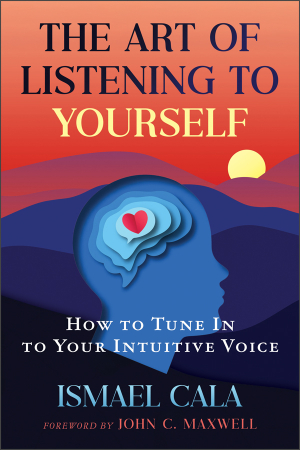
The Art of Listening to Yourself
How to Tune In to Your Intuitive Voice
By (Author) Ismael Cala
Foreword by John C. Maxwell
Availability:
Not yet published
- Pages: 320
- Book Size: 6.00 x 9.00
- ISBN-13: 9798888504635
- Imprint: Destiny Books
- On Sale Date: July 14, 2026
- Format: Paperback Book
- Illustrations: 46 b&w illustrations
Silence your inner critic and discover your inner wisdom
Ismael Cala teaches how to silence your inner critic and connect with your intuition. Through journaling exercises and mindfulness practices, he shows how to listen to your thoughts, body, emotions, and others from a place of non-judgment. Discover how to break free from automatic habits, recognize limiting beliefs, and cultivate deeper self-awareness and empathy.
Ismael Cala teaches how to silence your inner critic and connect with your intuition. Through journaling exercises and mindfulness practices, he shows how to listen to your thoughts, body, emotions, and others from a place of non-judgment. Discover how to break free from automatic habits, recognize limiting beliefs, and cultivate deeper self-awareness and empathy.

• Explores how to listen to your thoughts, body, emotions, intuition, and other people from a place of neutral self-assessment
• Explains how most of us respond to the world automatically based on mental habits
• Shares journaling exercises and mindfulness practices to enhance intuition and recognize limiting beliefs, biases, shadows, and weaknesses
Without realizing it, most of us tend to react based on our habits and memories, rather than what our senses, bodies, emotions, intuition, or the people around us convey. Ismael Cala explores how you can break free from these mental habits and discover the wisdom of your own inner voice to create a more balanced and fulfilling life.
Cala explains how to cultivate deeper self-awareness, strengthen intuition, and become more mindful through the art of non-judgmental listening. Drawing upon inspiring success stories, examples from his own life, as well as practical journaling exercises and powerful mindfulness practices, he explores ways to tune in to your inner dialogue from a place of critical self-reflection and neutral, loving self-assessment. He explains how to observe your thoughts as passing clouds rather than identifying with them as well as how to recognize limiting beliefs, biases, shadows, and weaknesses.
Examining the connections between the mind, heart, and body, Cala considers how emotions affect our physical well-being and how they can hinder our thoughts and reactions. By learning to listen to your body, you can better interpret what pain, discomfort, or stress may be signaling. He also shares strategies for listening to others with empathy for better communication and stronger relationships.
• Explains how most of us respond to the world automatically based on mental habits
• Shares journaling exercises and mindfulness practices to enhance intuition and recognize limiting beliefs, biases, shadows, and weaknesses
Without realizing it, most of us tend to react based on our habits and memories, rather than what our senses, bodies, emotions, intuition, or the people around us convey. Ismael Cala explores how you can break free from these mental habits and discover the wisdom of your own inner voice to create a more balanced and fulfilling life.
Cala explains how to cultivate deeper self-awareness, strengthen intuition, and become more mindful through the art of non-judgmental listening. Drawing upon inspiring success stories, examples from his own life, as well as practical journaling exercises and powerful mindfulness practices, he explores ways to tune in to your inner dialogue from a place of critical self-reflection and neutral, loving self-assessment. He explains how to observe your thoughts as passing clouds rather than identifying with them as well as how to recognize limiting beliefs, biases, shadows, and weaknesses.
Examining the connections between the mind, heart, and body, Cala considers how emotions affect our physical well-being and how they can hinder our thoughts and reactions. By learning to listen to your body, you can better interpret what pain, discomfort, or stress may be signaling. He also shares strategies for listening to others with empathy for better communication and stronger relationships.
Introduction
In your uniqueness lies the seed of your greatness.
I wish someone had told me this when I was seven or eight years old, as my mind began weaving a labyrinth of beliefs, self-judgments, and false narratives about that budding, insecure being that was little Ismael.
The mission of this book is to liberate the child trapped in the deception of an illusory story—a child who starts to listen and awaken the adult hidden among the shadows and burdens of his secrets. The secrets we hold in childhood are the most brutal short-sighted mirage that a human being faces in their true challenge: listening neutrally and lovingly to the dichotomy between who they believed they were, shaped by external conditioning, and who they truly are—beyond the limits of mind, ego, education, and genetic, epigenetic, and spiritual inheritances.
We were taught to speak and instructed to say “thank you” when requesting something, but we were barely taught to understand the complex world of listening. Many people have not allowed their ears to hear without the internal narration of the original script that defines their existence. This socially prescribed script is so strong that our minds and ears live in constant noise, denying the silence that is the master key to multidimensional listening: an ability to hear that involves cognition, emotion, the body, the electromagnetic field, and, most importantly, the dual-way relationship between what is hidden in our subconscious and what we unconsciously let penetrate it.
This book aims to elevate the quality of what enters your ears. If you apply everything it proposes, your life will never be the same, and your world will begin to flow with revelations and magic. It is an open book, brimming with secrets, both deeply private and commonly known. This is intended to help you understand and free that other book: the one filled with your own secrets that prevents you from being freer than the person you claim to be today.
We are happiest when we learn to listen to ourselves and liberate the book of our personal secrets. Without intervention, those thoughts we hear repeatedly in the echo chamber of our minds that make us feel shame, guilt, fear, and helplessness shape the identity of who we believe ourselves to be. Prepare to explore the “pinata of your mind”—a metaphor I like to use for how, when you were a child, adults filled your mind with ideas, paradigms, fears, limiting beliefs, and ways of seeing the world—just as one would fill a pinata with candy. However, also within this pinata is a fascinating path filled with light, truth, and immense love—a path that bridges science and consciousness and elevates us to the sacred within the mundane. This journey leads us to explore the infinite being that we truly are and transforms us into illustrious and virtuous students of the art of listening.
Many of us are likely born equally gifted with grace, innocence, and boundless magic. But this state of pure magic is fleeting. Our origins of profound bliss and connection begin to fade when the pinata mind of the child starts receiving orders, labels, and memes that confine it—when fears are transferred (without malice) by our parents, alongside an absurd avalanche of biases and conditioning. These forces overshadow that infinite, whole being, who, left unaltered, would never have conformed to the herd.
“Education is the rush to conformity,” I once read in a powerful statement. I believe this is true: education often becomes a process designed to ensure our belonging to a family, a culture, a country, or even a religious sect. It frames us in limiting ways or shapes our individual identity alongside a fragmented sense of social belonging. Leave a child without education, and you’ll have someone lacking many social skills—but perhaps a person more connected to their essence and in tune with nature.
This book is a study of loving and neutral listening, both internal and external. This listening can replace and heal the conditioned listening filled with limiting thoughts, words, ideas, beliefs, and assumptions rooted in our upbringing—the listening that, over time, became the false truths about who we believe ourselves to be in the world. It is an invitation to activate critical and reflective thinking—not positive thinking, but rather the ability to listen to and accept even the parts of ourselves we don’t like or the secret ideas that pass through our minds.
On this journey, your shadows and darker aspects—that many consider to be their worst enemy—will emerge. However, for us, as explorers of consciousness, the shadow or dark side is simply part of who we are—or who we are not. Often, our shadow simply reflects what we have gathered, inherited, or recycled from our environment, surroundings, or the psycho-emotional legacy that has shaped our personalities.
Often, in the true and nonjudgmental process of listening to ourselves, we fear admitting things that make us a “bad person” (or, at least, that’s how it feels). However, even the fear of losing control, the fear of not knowing ourselves, of loneliness, abandonment, and rejection, are great allies. These are all indicators that we are beginning to recognize who we are in the fragile yet perfectly imperfect nature of humans evolving toward higher consciousness.
I now understand that most humans deny themselves (out of fear) the opportunity to discover who truly lives within. Instead, they choose the difficult task of continuing to please others, crafting an illusion of being someone who fits the expectations of society in an overwhelming need for acceptance and belonging.
You and I are here to look each other in the eye, tell each other the truth, and open the book of our secrets to begin liberating them—breaking free from the distorted illusion that these secrets have left us weak or as victims of certain events. The Art of Listening to Yourself leads you down the path of erasing all traces of victimhood. Because, in the end, it is not your emotions that should dictate the level of your consciousness, but your serene and neutral presence, and capacity for critical thinking to even call into question your own interpretations of reality.
There is a shadow within every human, filled with doubts, disturbances, and darkness—a shadow often brimming with more questions than answers. Being explorers means shining a light into every corner where fear, doubt, distrust, and even feelings of unworthiness have hidden. This shadow must be faced with compassion and immense love and filled with empathy; this is the only way to truly know what resides within our subconscious and confront it.
Without compassion for our shadow, life becomes a calvary of friction and overwhelm—a tug-of-war between our noble intentions for expansion and the inevitable contractions caused by the habit of replaying our old stories. Broadcast endlessly, these stories defy the mission of your life: to believe, create, and grow without limits.
The voices of the shadow come uninvited, discrediting others, passing judgment, and, above all, comparing you to others in an unfair and biased way. Remember that every time we believe those voices in our pinata mind, we are projecting—and projecting is dehumanizing. That’s when the shadow darkens us, and we start justifying our complaints, hatred, envy, and, above all, the unloving actions that others receive. If we think certain people are “bad,” then our minds believe they deserve whatever actions we take against them.
Creating peace through listening is the philosophy for banishing hatred and pain.
No one escapes that brutal process that cages us in the house of the familiar, the known, the “safe.” We all, in one way or another, still carry voices in our pinata mind that act either as anchors for expansion and reinforcement or as invisible shackles, seemingly unbreakable to those who bear them. We move through the world like circus elephants, trained and conditioned to display certain behaviors from the time we were defenseless and had no self-awareness. Our illusion of subjectivity in an apparently solid and scientific world has caused us to memorize data that distorts the narrative of who we truly are.
You and I have been left at the mercy of memory—full of knowledge, but orphans of wisdom. Yet our personality is not etched in stone; it is not our Rosetta Stone. Rather, it is possible to evolve and escape the mediocre path of being “average” in a universe where our excessive sameness is more a curse of learned apathy and hopelessness than a virtue of what we were born to be with our original rights.
In your uniqueness lies the seed of your greatness.
I wish someone had told me this when I was seven or eight years old, as my mind began weaving a labyrinth of beliefs, self-judgments, and false narratives about that budding, insecure being that was little Ismael.
The mission of this book is to liberate the child trapped in the deception of an illusory story—a child who starts to listen and awaken the adult hidden among the shadows and burdens of his secrets. The secrets we hold in childhood are the most brutal short-sighted mirage that a human being faces in their true challenge: listening neutrally and lovingly to the dichotomy between who they believed they were, shaped by external conditioning, and who they truly are—beyond the limits of mind, ego, education, and genetic, epigenetic, and spiritual inheritances.
We were taught to speak and instructed to say “thank you” when requesting something, but we were barely taught to understand the complex world of listening. Many people have not allowed their ears to hear without the internal narration of the original script that defines their existence. This socially prescribed script is so strong that our minds and ears live in constant noise, denying the silence that is the master key to multidimensional listening: an ability to hear that involves cognition, emotion, the body, the electromagnetic field, and, most importantly, the dual-way relationship between what is hidden in our subconscious and what we unconsciously let penetrate it.
This book aims to elevate the quality of what enters your ears. If you apply everything it proposes, your life will never be the same, and your world will begin to flow with revelations and magic. It is an open book, brimming with secrets, both deeply private and commonly known. This is intended to help you understand and free that other book: the one filled with your own secrets that prevents you from being freer than the person you claim to be today.
We are happiest when we learn to listen to ourselves and liberate the book of our personal secrets. Without intervention, those thoughts we hear repeatedly in the echo chamber of our minds that make us feel shame, guilt, fear, and helplessness shape the identity of who we believe ourselves to be. Prepare to explore the “pinata of your mind”—a metaphor I like to use for how, when you were a child, adults filled your mind with ideas, paradigms, fears, limiting beliefs, and ways of seeing the world—just as one would fill a pinata with candy. However, also within this pinata is a fascinating path filled with light, truth, and immense love—a path that bridges science and consciousness and elevates us to the sacred within the mundane. This journey leads us to explore the infinite being that we truly are and transforms us into illustrious and virtuous students of the art of listening.
Many of us are likely born equally gifted with grace, innocence, and boundless magic. But this state of pure magic is fleeting. Our origins of profound bliss and connection begin to fade when the pinata mind of the child starts receiving orders, labels, and memes that confine it—when fears are transferred (without malice) by our parents, alongside an absurd avalanche of biases and conditioning. These forces overshadow that infinite, whole being, who, left unaltered, would never have conformed to the herd.
“Education is the rush to conformity,” I once read in a powerful statement. I believe this is true: education often becomes a process designed to ensure our belonging to a family, a culture, a country, or even a religious sect. It frames us in limiting ways or shapes our individual identity alongside a fragmented sense of social belonging. Leave a child without education, and you’ll have someone lacking many social skills—but perhaps a person more connected to their essence and in tune with nature.
This book is a study of loving and neutral listening, both internal and external. This listening can replace and heal the conditioned listening filled with limiting thoughts, words, ideas, beliefs, and assumptions rooted in our upbringing—the listening that, over time, became the false truths about who we believe ourselves to be in the world. It is an invitation to activate critical and reflective thinking—not positive thinking, but rather the ability to listen to and accept even the parts of ourselves we don’t like or the secret ideas that pass through our minds.
On this journey, your shadows and darker aspects—that many consider to be their worst enemy—will emerge. However, for us, as explorers of consciousness, the shadow or dark side is simply part of who we are—or who we are not. Often, our shadow simply reflects what we have gathered, inherited, or recycled from our environment, surroundings, or the psycho-emotional legacy that has shaped our personalities.
Often, in the true and nonjudgmental process of listening to ourselves, we fear admitting things that make us a “bad person” (or, at least, that’s how it feels). However, even the fear of losing control, the fear of not knowing ourselves, of loneliness, abandonment, and rejection, are great allies. These are all indicators that we are beginning to recognize who we are in the fragile yet perfectly imperfect nature of humans evolving toward higher consciousness.
I now understand that most humans deny themselves (out of fear) the opportunity to discover who truly lives within. Instead, they choose the difficult task of continuing to please others, crafting an illusion of being someone who fits the expectations of society in an overwhelming need for acceptance and belonging.
You and I are here to look each other in the eye, tell each other the truth, and open the book of our secrets to begin liberating them—breaking free from the distorted illusion that these secrets have left us weak or as victims of certain events. The Art of Listening to Yourself leads you down the path of erasing all traces of victimhood. Because, in the end, it is not your emotions that should dictate the level of your consciousness, but your serene and neutral presence, and capacity for critical thinking to even call into question your own interpretations of reality.
There is a shadow within every human, filled with doubts, disturbances, and darkness—a shadow often brimming with more questions than answers. Being explorers means shining a light into every corner where fear, doubt, distrust, and even feelings of unworthiness have hidden. This shadow must be faced with compassion and immense love and filled with empathy; this is the only way to truly know what resides within our subconscious and confront it.
Without compassion for our shadow, life becomes a calvary of friction and overwhelm—a tug-of-war between our noble intentions for expansion and the inevitable contractions caused by the habit of replaying our old stories. Broadcast endlessly, these stories defy the mission of your life: to believe, create, and grow without limits.
The voices of the shadow come uninvited, discrediting others, passing judgment, and, above all, comparing you to others in an unfair and biased way. Remember that every time we believe those voices in our pinata mind, we are projecting—and projecting is dehumanizing. That’s when the shadow darkens us, and we start justifying our complaints, hatred, envy, and, above all, the unloving actions that others receive. If we think certain people are “bad,” then our minds believe they deserve whatever actions we take against them.
Creating peace through listening is the philosophy for banishing hatred and pain.
No one escapes that brutal process that cages us in the house of the familiar, the known, the “safe.” We all, in one way or another, still carry voices in our pinata mind that act either as anchors for expansion and reinforcement or as invisible shackles, seemingly unbreakable to those who bear them. We move through the world like circus elephants, trained and conditioned to display certain behaviors from the time we were defenseless and had no self-awareness. Our illusion of subjectivity in an apparently solid and scientific world has caused us to memorize data that distorts the narrative of who we truly are.
You and I have been left at the mercy of memory—full of knowledge, but orphans of wisdom. Yet our personality is not etched in stone; it is not our Rosetta Stone. Rather, it is possible to evolve and escape the mediocre path of being “average” in a universe where our excessive sameness is more a curse of learned apathy and hopelessness than a virtue of what we were born to be with our original rights.
Foreword:
The Path of Integrity
by John C. Maxwell
Prologue
by Dr. César Lozano
An Invitation to Seek Common Ground
by Anne Igartiburu
Introduction
1 Knowing Yourself
2 Listening to Your Mind
3 Listening to Your Body
4 Listening to Your Emotions
5 Listening to Ourselves
6 The Voice of Intuition
Conclusion
Epilogue
Acknowledgments
Bibliography
Index
The Path of Integrity
by John C. Maxwell
Prologue
by Dr. César Lozano
An Invitation to Seek Common Ground
by Anne Igartiburu
Introduction
1 Knowing Yourself
2 Listening to Your Mind
3 Listening to Your Body
4 Listening to Your Emotions
5 Listening to Ourselves
6 The Voice of Intuition
Conclusion
Epilogue
Acknowledgments
Bibliography
Index
Ismael Cala is a Cuban journalist, bestselling author, international lecturer, and visionary producer. Recognized as a global authority in executive mindfulness, innovation, productivity, and high performance, his work inspires leaders and dreamers alike to unlock their highest potential. He is the creator and host of the acclaimed podcast The Abundance Revolution and resides in Miami, Florida.
“Ismael Cala has gifted us with a life-changing resource in The Art of Listening to Yourself. By illuminating the power of inner listening, this book provides a guide to personal growth and wisdom that we desperately need. Cala reveals how tuning in to our bodies and spirits allows us to access our highest potential. With his trademark insight and compassion, Cala shows us how to quiet our busy minds to hear divine guidance. We can transform relationships and heal wounds when we truly listen. By listening, we can understand what our bodies are trying to tell us, leading to better health. The Art of Listening to Yourself is a revelation and a revolution. Cala is a pioneering voice teaching ancient truths for modern times, empowering us to create lives of meaning, harmony, and purpose. When we learn to listen, we unlock our greatest gifts. The world needs this light now more than ever.” John C. Maxwell, leadership expert and #1 New York Times bestselling author of The 21 Irrefutable Laws of Leadership
“A deeply insightful book for anyone ready to rise.” Robin Sharma, #1 international bestselling author of The 5AM Club and The Monk Who Sold His Ferrari
“In The Art of Listening to Yourself, Ismael Cala brings his signature warmth, generosity, and uplifting spirit to one of our most essential capacities: the ability to listen deeply, beginning with ourselves. In a world that pulls our attention in a thousand directions, this book offers a much-needed reprieve. Through practical exercises in self-reflection, journaling, self-observation, and mindful attention, the reader is invited to step out of habitual reactivity and strengthen the inner capacities that support clarity, intuition, resilience, and wise action. A gem of a book that is both timely and inspiring.” Amishi Jha, PhD, neuroscientist and author of Peak Mind
“With eloquence and depth, The Art of Listening to Yourself invites us to embark on a journey of self-discovery. Ismael Cala’s powerful teachings ignite a spark of curiosity and encourage us to tune in to our inner wisdom, ultimately guiding us to live more fulfilling and intentional lives.” Jason Silva, Emmy-nominated and world renowned TV personality, artist, and filmmaker
“The Art of Listening to Yourself is a quiet revolution in a noisy world. With clarity and warmth, it guides readers back to their own inner wisdom, reminding us that the answers we seek have been within us all along. A powerful invitation to slow down, tune in, and trust yourself.” Carolina Herrera, fashion designer
“With uplifting poems, eloquent visuals, and thoughtful reflective exercises, The Art of Listening to Yourself by Ismael Cala guides readers through the terrain of mind, body, and emotions with clarity and depth. It reveals how to move beyond memory and conditioning by truly listening to the voices within—and finally becoming the conscious author of your own life story. A compelling must-read for anyone ready to discover the light of wisdom within.” Anuradha Dayal-Gulati, PhD, author of Heal Your Ancestral Roots
“A deeply insightful book for anyone ready to rise.” Robin Sharma, #1 international bestselling author of The 5AM Club and The Monk Who Sold His Ferrari
“In The Art of Listening to Yourself, Ismael Cala brings his signature warmth, generosity, and uplifting spirit to one of our most essential capacities: the ability to listen deeply, beginning with ourselves. In a world that pulls our attention in a thousand directions, this book offers a much-needed reprieve. Through practical exercises in self-reflection, journaling, self-observation, and mindful attention, the reader is invited to step out of habitual reactivity and strengthen the inner capacities that support clarity, intuition, resilience, and wise action. A gem of a book that is both timely and inspiring.” Amishi Jha, PhD, neuroscientist and author of Peak Mind
“With eloquence and depth, The Art of Listening to Yourself invites us to embark on a journey of self-discovery. Ismael Cala’s powerful teachings ignite a spark of curiosity and encourage us to tune in to our inner wisdom, ultimately guiding us to live more fulfilling and intentional lives.” Jason Silva, Emmy-nominated and world renowned TV personality, artist, and filmmaker
“The Art of Listening to Yourself is a quiet revolution in a noisy world. With clarity and warmth, it guides readers back to their own inner wisdom, reminding us that the answers we seek have been within us all along. A powerful invitation to slow down, tune in, and trust yourself.” Carolina Herrera, fashion designer
“With uplifting poems, eloquent visuals, and thoughtful reflective exercises, The Art of Listening to Yourself by Ismael Cala guides readers through the terrain of mind, body, and emotions with clarity and depth. It reveals how to move beyond memory and conditioning by truly listening to the voices within—and finally becoming the conscious author of your own life story. A compelling must-read for anyone ready to discover the light of wisdom within.” Anuradha Dayal-Gulati, PhD, author of Heal Your Ancestral Roots
PERSONAL GROWTH/SELF-TRANSFORMATION
"The Art of Listening to Yourself is a revelation and a revolution. By illuminating the power of inner listening, this book provides a guide to personal growth and wisdom that we desperately need."
–JOHN C. MAXWELL, #1 New York Times bestselling author and leadership expert
"A deeply insightful book for anyone ready to rise."
–ROBIN SHARMA, #1 international bestselling author of The 5AM Club and The Monk Who Sold His Ferrari
Without realizing it, most of us tend to react based on our habits and memories, rather than what our senses, bodies, emotions, intuition, or the people around us convey. Ismael Cala explores how you can break free from these mental habits and discover the wisdom of your own inner voice to create a more balanced and fulfilling life.
Cala explains how to cultivate deeper self-awareness, strengthen intuition, and become more mindful through the art of non-judgmental listening. Drawing upon inspiring success stories, examples from his own life, as well as practical journaling exercises and powerful mindfulness practices, he explores ways to tune in to your inner dialogue from a place of critical self-reflection and neutral, loving self-assessment. He explains how to observe your thoughts as passing clouds rather than identifying with them as well as how to recognize limiting beliefs, biases, shadows, and weaknesses.
Examining the connections between the mind, heart, and body, Cala considers how emotions affect our physical well-being and how they can hinder our thoughts and reactions. By learning to listen to your body, you can better interpret what pain, discomfort, or stress may be signaling. He also shares strategies for listening to others with empathy for better communication and stronger relationships.
ISMAEL CALA is a Cuban journalist, bestselling author, international lecturer, and visionary producer. Recognized as a global authority in executive mindfulness, innovation, productivity, and high performance, his work inspires leaders and dreamers alike to unlock their highest potential. He is the creator and host of the acclaimed podcast The Abundance Revolution and resides in Miami, Florida.
"The Art of Listening to Yourself is a revelation and a revolution. By illuminating the power of inner listening, this book provides a guide to personal growth and wisdom that we desperately need."
–JOHN C. MAXWELL, #1 New York Times bestselling author and leadership expert
"A deeply insightful book for anyone ready to rise."
–ROBIN SHARMA, #1 international bestselling author of The 5AM Club and The Monk Who Sold His Ferrari
Without realizing it, most of us tend to react based on our habits and memories, rather than what our senses, bodies, emotions, intuition, or the people around us convey. Ismael Cala explores how you can break free from these mental habits and discover the wisdom of your own inner voice to create a more balanced and fulfilling life.
Cala explains how to cultivate deeper self-awareness, strengthen intuition, and become more mindful through the art of non-judgmental listening. Drawing upon inspiring success stories, examples from his own life, as well as practical journaling exercises and powerful mindfulness practices, he explores ways to tune in to your inner dialogue from a place of critical self-reflection and neutral, loving self-assessment. He explains how to observe your thoughts as passing clouds rather than identifying with them as well as how to recognize limiting beliefs, biases, shadows, and weaknesses.
Examining the connections between the mind, heart, and body, Cala considers how emotions affect our physical well-being and how they can hinder our thoughts and reactions. By learning to listen to your body, you can better interpret what pain, discomfort, or stress may be signaling. He also shares strategies for listening to others with empathy for better communication and stronger relationships.
ISMAEL CALA is a Cuban journalist, bestselling author, international lecturer, and visionary producer. Recognized as a global authority in executive mindfulness, innovation, productivity, and high performance, his work inspires leaders and dreamers alike to unlock their highest potential. He is the creator and host of the acclaimed podcast The Abundance Revolution and resides in Miami, Florida.
The Missing Element
$16.99
save
$2.85
8 Universal Laws
Special Price
$16.14
Regular Price
$18.99
Scripting the Life You Want
$16.99