


Maurice Nicoll: Forgotten Teacher of the Fourth Way
By Gary Lachman, author of Maurice Nicoll, The Return of Holy Russia, and Touched by the Presence
On November 4, 1922, Maurice Nicoll—the prestigious Harley Street physician, author, and, until only recently, British lieutenant of the psychologist C. G. Jung—arrived at the Prieuré de Basses Loges in the forest of Fontainebleau, just outside of Paris. With him were his young wife, their infant daughter, his sister-in-law, and the nanny. The thirty-six year old Nicoll had sold his successful practice and borrowed against an inheritance from his father —the celebrated political thinker William Robertson Nicoll—in order to secure a place at the newly-opened Institute for the Harmonious Development of Man, an educational establishment offering a unique curriculum. The institute was led by G.I. Gurdjieff, a mysterious individual with a strange background who, Nicoll believed, possessed the esoteric knowledge he had sought for many years. Gurdjieff had travelled in exotic lands, studying with the teachers of an ancient spiritual doctrine, and was now offering this knowledge to his students.
Nicoll, who wrote one of the earliest books in English on Jung’s psychology, heard of Gurdjieff through another esoteric teacher, the Russian P. D. Ouspensky.Brought to England’s shores by the collapse of Czarist Russia, Ouspesnky was the author of Tertium Organum, a bestselling work of metaphysics, Ouspensky’s lectures on Gurdjieff’s teaching—a stark, unsentimental regimen designed to waken its practitioners from a state of mechanicalness that Gurdjieff called “sleep”— attracted many of London’s intellectual luminaries. Nicoll, whom Jung had seen as carrying on his work in England, changed his allegiance after hearing Oupensky and broke with Jung, a parting for which the sage of Kusnacht never forgave him. From then until his death in 1953, Nicoll practiced “the Work,” the homely name given to Gurdjieff’s system—first under Gurdjieff, then with Ouspenky, eventually teaching it himself for many years in several “off the grid” communities he established outside London.
Nicoll is perhaps most known for a series of weekly talks on various “work” topics he gave to his groups over the years, collected in the volumes of his Psychological Commentaries on the teaching of Gurdjieff and Ouspensky. Among its many readers include the economist E. F. Schumacher, author of the classic Small is Beautiful; the comedian John Cleese; and the writer J. B. Priestley, who called Nicoll another “time-haunted man”, and whose plays, such as Time and the Conways, deal with themes that Nicollalso pursued. Nicoll also wrote two texts on the Gospels—The New Man and The Mark—in which he presents the essence of his “esoteric Christianity,” Nicoll’s contribution to the teaching of the Fourth Way, as Gurdjieff’s system is also known. Nicoll also wrote Living Time, a text that looks at our experience of time from the standpoint of esoteric psychology. What is less known about Nicoll is that in his early career, under the pseudonym Martin Swayne, he was a bestselling author and a regular contributor to the popular Strand magazine.
Having Jung, Gurdjieff, and Ouspensky as teachers is enough to make Nicoll an interesting subject, and his development of and unique contribution to their ideas suggest a new look at his life and work would be welcome. Among the teachers of the Fourth Way, Nicoll comes across as the most approachable. He is not the “crazy guru” that Gurdjieff sometimes could be, or a dry logician like Ouspensky. Nicoll is rather more like a country doctor or vicar, someone you could share a pint with at the pub, which his students often did. Yet, for all his interest and importance, Nicoll is not well-known. Most readers of Jung are unaware of Nicoll’s important book, Dream Psychology, while many followers of the Fourth Way may have heard of Nicoll tangentially, as one of Gurdjieff’s students, but have no clear idea what he was about.
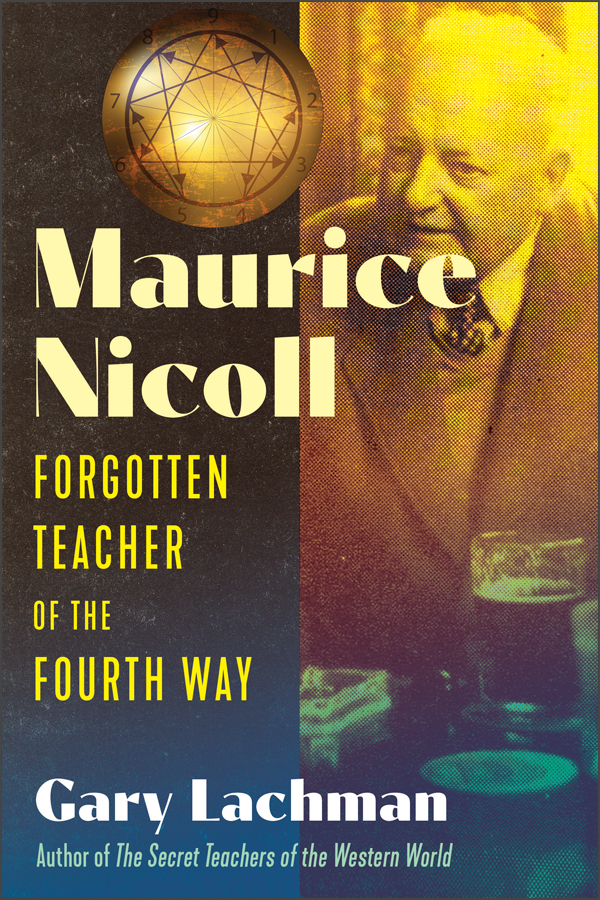
Early biographical portraits were written by Nicoll’s students, but no objective, unbiased, sympathetic but critical, account of Nicoll’s life and ideas exists. Until now. My book, Maurice Nicoll: Forgotten Teacher of the Fourth Way, is the first to look at Nicoll’s life and work as a whole, and to place it in the context of the esoteric, cultural, and intellectual movements of the twentieth century. Nicoll was an important player in the early days of psychoanalysis, in at the beginning of Jung’s work; he was among the first to submit to Gurdjieff’s teaching in the formidable environment of the Institute, and later, under Ouspensky in London; and toward the end of his life, Nicoll found more spiritual guidance in the eighteenth century Swedish scientist and visionary Emanuel Swedenborg’s own esoteric reading of scripture. Readers unaware of Nicoll’s early tutelage under Jung may not notice the several Jungian themes that appear throughout his Commentaries, just as they may not notice the several Swedenborgian ones that appear in later entries.
My book looks at Nicoll’s unique blend of “the Work” with elements from Jung and Swedenborg that gives Nicoll’s contribution to the Fourth Way a characteristic flavour, one that seems to have sidelined him among the purists. My book is also the first to examinediaries that Nicoll kept in the years just before his meeting with Gurdjieff and later during the 1940s, only recently uncovered by scholars, after languishing unsuspected for years. These diaries, which reach more than one thousand pages,are a unique document and present considerable difficulties for a reader. For the most part, they are a record of Nicoll’s dream life, written in a fragmentary fashion, often using different codes, and include everyday matters, random jottings, metaphysical speculation, and stream of consciousness ramblings. They record Nicoll’s growing dissatisfaction with Jung’s ideas, and his increasing attraction to Ouspensky, with whom he became friends. The later diaries offer some fascinating insights into life in England during World War II, as one of Nicoll’s “off the grid” establishments was requisitioned to house mothers and children escaping the Blitz.
But one thing the diaries do make clear is Nicoll’s fascination, one might almost say obsession, with sex—something that I think will come as a surprise to most readers; it certainly did to me. The diaries reveal how Nicoll went about pursuing this obsession, with pages and pages given over to what appears to have been a strange auto-erotic ritual Nicoll practiced in order to achieved exalted states of consciousness. As I try to show, Nicoll’s pursuit of esoteric knowledge and experience—what he called the ‘vertical’ dimension of our being—and his pursuit of a particular kind of eroto-mystical ecstasy were part of the same quest. Sexuality and spirituality are not strange bedfellows, although their union often produces strange results. As I show in the book, the results Nicoll produced were no exception.
Throughout his time leading his groups in London and the Home Counties, Nicoll kept a low profile; he was one of those whom I have called “secret teachers.” Yet, in his last days, members of Nicoll’s groups numbered several hundred, many travelling miles to take part in the “work weekends” during which Nicoll would put into practice on a large scale the practical ideas about self-development he had learned, years ago, in Fontainebleau. He may be a forgotten teacher of the Fourth Way, but I hope that, by writing my book, he does not remain one for long.
Gary Lachman is an author and lecturer on consciousness, counterculture, and the Western esoteric tradition. His works include Dark Star Rising, Beyond the Robot, The Return of Holy Russia, and The Secret Teachers of the Western World. A founding member of the rock band Blondie, he was inducted into the Rock and Roll Hall of Fame in 2006. He lives in London. https://www.gary-lachman.com/
 |
 |
 |
Recommended Reading:
Forgotten Teacher of the Fourth Way by Gomery Kimber
Of Beauty and the Invisibility of Man from The Times of Israel
 Inner Traditions
  Bear & Company
  Findhorn Press
  Earthdancer Books
  Park Street Press
  Healing Arts Press
  Destiny Books
  Sacred Planet Books
  Bear Cub Books
  Inner Traditions en Español