

by Connie Zweig, Ph.D., author of The Inner Work of Age: Shifting from Role to Soul
We have lost our guides for moving through the transitions of our older years and for becoming Elders ourselves. We are aging without a map. So, how can we find the treasures of this stage? In my workshops, most participants over 60 describe this identity crisis. They report feeling disoriented, without direction, groping in the dark. And they feel marginalized, invisible and unimportant, just as they finally begin to know who they are.
As we start to share the framework of my book — the idea that late life is a call to another rite of passage — and use the practices outlined within it, the participants tell me that they discover how to center themselves and find a new orientation in space and time. As one woman told me, “Oh, I’ve had an identity crisis before. I’ve heeded a call to change. I know how to do this. What was frightening me before is familiar to me now with this framework.”
As one man said, “In midlife, I was always striving to progress, to move forward. It doesn’t feel right to say that I’m moving forward now. It’s more like I’m moving further, still growing but in a totally different way at a different pace.”
Another woman told me that, when she turned 70, she couldn’t find an internal GPS for this period. She had no navigator and no destination, until she learned, with the inner work of age, how to orient toward soul.
And, importantly, most of us are not aware that we are in denial of our aging, struggling with internal obstacles or unconscious part selves that block our development and the flow of our lives. These “shadow characters” resist transition and impede us from discovering the hidden power of late life. They reinforce the walls of denial out of fear of change or loss, keeping us stuck in archaic roles and identities for years, which leads to an absence of aliveness and stagnation, even depression. Under the guise of protecting us from risk, they sabotage us by standing guard at the threshold, shutting down our spiritual longing and silencing the whispers of our soul. So, in the clutches of an internal character, we fail to cross over and enter a new stage of development. We fail to fulfill our destiny.
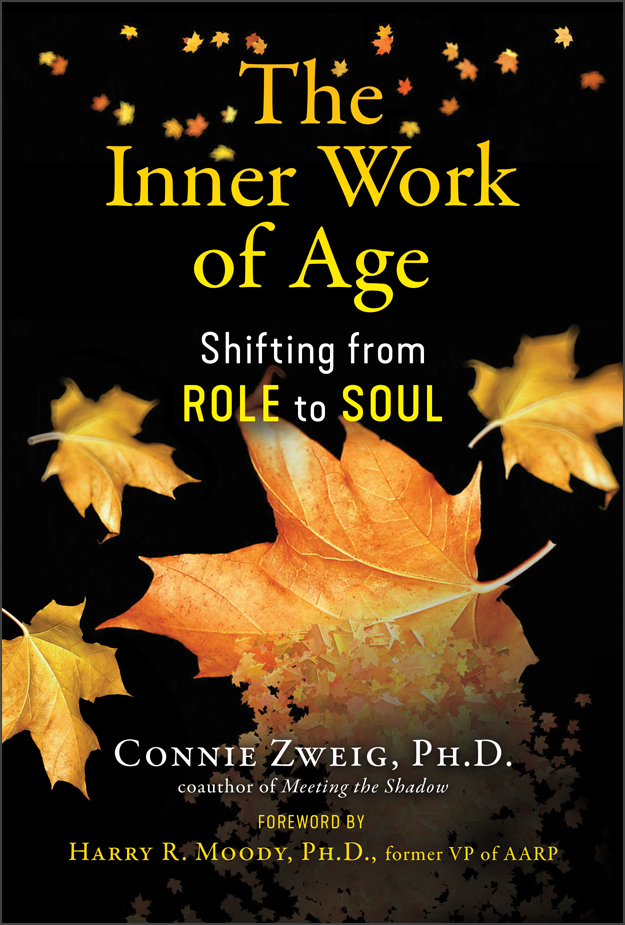
That is the purpose of my book The Inner Work of Age: to guide you past denial to the inner work that allows you to fully respond to the divine messengers. Then you have the freedom to make the transitions in late life as meaningful and rewarding as they can be. As a result, you can age from the inside out.
Ron Pevny, founder of the Center for Conscious Eldering, points out that for life transitions to become successful rites of passage, they require three steps: 1) Letting go refers to leaving behind past roles, attitudes, regrets, and identities that no longer serve our development, so that we can move forward; 2) Liminal time, or the neutral zone, refers to the fallow period between identities, in which we feel lost, formless, empty, and afraid. It’s a bit like a chrysalis — no longer caterpillar, not yet butterfly. And it may include deep grieving for all that has been lost; 3) New beginnings refers to the emergence of a new sense of self, passion, purpose, and vision. I would add, a potential next stage of awareness.
During the passages of retirement, emotional repair, spiritual repair, illness and caregiving, becoming an Elder, sacred service, and cultivating spiritual development, these three steps of transition are key. In fact, they describe the evolution of the soul as we move through these passages, shedding skins and emerging anew. Ken Wilber describes this evolutionary process as transcending one stage of awareness, while including the previous stages.
For instance, as we transcend midlife, letting go of the roles and responsibilities of this time, we may enter a neutral zone, in which we feel not young/not old. We are between clear-cut roles and identities, still active and engaged, but not quite sure who we are anymore. We are no longer primarily parents or primarily our work roles. There is a fundamental anxiety in the neutral zone with its uncertainty and absence of labels, and with its built-in loss of the past.
Eventually, with inner work, we move beyond midlife and cross a threshold into late life, emerging as an Elder. We let go of the striving and pushing; we let go of the “shoulds.” We release our past identities but carry all that we’ve learned, all that we love, always, within us. In this way, evolution is moving from role to soul.
The words “transition” and “transcend” both have the prefix “trans,” meaning to cross over or go beyond. A transition is a passage to a next stage of life, both internal and external, such as from child to adolescent, from single to married adult, from senior to Elder, that was traditionally marked by sacred rites. These stages are social constructs that enable us to name and support the transition. For instance, “adolescence” was coined in 1904 to describe the stage between childhood and adulthood and to focus society on the needs of people at that stage.
But our time of life today, between retirement and frail old age, remains unnamed and therefore unserved. And, because of this conceptual deficit, our vision is deficient too. As renowned gerontologist Bill Thomas says, “We suffer from aging illiteracy.”
On the other hand, “transcendence” is an internal shift to another level of awareness, a change in stage, not age. When we complete the developmental tasks described here for each arena of life, when we move through them consciously, releasing the past, stepping into the unknown, and emerging on the other side, we can transcend the ego’s past identity and begin to live from a different center of gravity, such as from hero to Elder.
If we continue to transcend earlier roles and identities, eventually transcending ego and awakening into higher stages of awareness, we can become Spiritual Elders. That is, our ego development includes inner work leading to adult maturity (Ken Wilber calls this Growing Up), and our spiritual development beyond ego includes inner work leading to awakening (Wilber calls this Waking up).
This vision of aging as a spiritual journey is not a new idea. Most of the world’s spiritual traditions envision late life as a time for retreat from the world, contemplation, and ego transcendence. More recently, Carl Jung pointed out that the root of his patients’ post-midlife problems was lack of a spiritual outlook.
Rabbi Zalman Schacter-Shalomi, whose book, From Age-ing to Sage-ing (with Ron Miller), and organization, Sage-ing International, inspired me to write my book, said it this way: “Without envisioning old age as the culminating stage of spiritual development, we short-circuit this process and put brakes on the evolutionary imperative for growth. We are driven by this instinct for life completion as an individual and as a species still evolving.”
I believe this instinct for life completion is how our spiritual yearning, or holy longing, appears in late life. It’s the evolutionary force within us that seeks the shift from role to soul.
 |
 |
 |
 |
 |
 |
 Inner Traditions
  Bear & Company
  Findhorn Press
  Earthdancer Books
  Park Street Press
  Healing Arts Press
  Destiny Books
  Sacred Planet Books
  Bear Cub Books
  Inner Traditions en Español